The Comedy of Errors — Semester I: twelve weeks of reading aloud, narration, living books, Shakespeare's own language, and family delight. Semester II: twelve weeks of rehearsal leading to a performance of an abbreviated adaptation.
Read it in parts. Narrate it. Meet the characters. Grow familiar with Shakespeare's language. Follow interesting rabbit holes without making the extras the point.
Students will move from readers to players as we cast, rehearse, memorize selected scenes, work on comic timing and character, add simple costumes and props, and prepare an abbreviated version of the play for performance.
Week 1 introduces the feast. Weeks 2–11 read the entire play. Week 12 is a Shakespeare festa. The in-class meeting stays around twenty minutes; the home resources can expand as far as a family wants.
At home: preview the character list and twin map. Optional: read the whole Nesbit retelling once so the plot is familiar before the original scenes begin.
CM focus: Shakespeare as lifelong feast, not a decoding exercise.
Home reading: Act 1, Scene 1 aloud in parts.
Optional rabbit hole: Ancient Greek comedy: what did “comedy” mean before Shakespeare?
Home reading: Act 1, Scene 2.
Optional rabbit hole: Plautus and Roman twin comedy. Shakespeare borrowed the basic twin plot of Menaechmi and intensified it.
Home reading: Act 2, Scene 1.
CM focus: relationship with characters before literary terminology.
Home reading: Act 2, Scene 2.
CM focus: let repeated exposure teach the ear; use annotations only when needed.
Home reading: Act 3, Scene 1.
Optional rabbit hole: farce, entrances, exits, doors, and precise timing.
Home reading: Act 3, Scene 2.
Optional rabbit hole: commedia dell'arte, masks, improvisation, and stock characters.
Home reading: Act 4, Scenes 1–2.
CM focus: narration may follow one thread instead of summarizing everything.
Home reading: Act 4, Scene 3.
CM focus: point-of-view narration.
Home reading: Act 4, Scene 4.
Optional rabbit hole: silent film and visual comedy.
Home reading: Act 5, Scene 1.
CM focus: tell what the whole play has come to mean, rather than answering a worksheet.
Dress as a character, comic archetype, Elizabethan theatre-goer, Roman player, or silent-film comedian. Bring commonplace books, illustrations, character maps, favorite lines, and one small scene to read or perform.
The play itself remains the center. Retellings, podcasts, history, glossaries, and videos are servants of the living work — useful when they open a door, never substitutes for meeting Shakespeare.
Charlotte Mason families have long used Shakespeare as part of a rich feast of living books, read aloud in character, narrated naturally, and returned to over many years. This course follows that spirit: meet the play itself, enjoy the language, and let the story grow familiar through repeated, delightful encounters.
Charlotte Mason Shakespeare resources ↗After a scene or natural chunk, close the book. Give students the dignity of organizing what they heard before the teacher begins explaining.
Read once with attention, preferably aloud and in character.
Close the text. Resist the urge to lecture immediately.
“Tell me what happened.” Let the student choose order and emphasis.
Then discuss one or two genuinely interesting things.
Use the retellings lightly and freely. They are there to help a child see the path through the forest of twins — then return to Shakespeare.
Folger's free text can be read scene by scene and downloaded in multiple formats. This is the text around which the semester is built.
Read at Folger ↗Beautiful Stories from Shakespeare contains a shorter retelling of The Comedy of Errors and is public domain in the United States.
Read / download free ↗Tales from Shakespeare was written as an introduction for young readers and preserves Shakespeare's words where the Lambs could.
Read / download free ↗Confident family: go straight to Shakespeare. Lost in the twins: read Nesbit first. Enjoys richer prose: try Lamb. No family needs to read all three every week.
All of the listening resources you sent are collected here with clear titles, so families can tell exactly what they are before clicking.
The Literary Life — Angelina Stanford and Thomas Banks discuss approaching Shakespeare as an ordinary reader, reading with children, forms of the plays, and whether to read or watch first.
Listen / show notes ↗The Play's the Thing — first half of a two-part exploration of Shakespeare's life.
Listen on Spotify ↗The Play's the Thing — the second half of the Shakespeare biography.
Listen on Spotify ↗The Play's the Thing — Shakespeare questions from a family of readers.
Listen on Spotify ↗The Play's the Thing — a dedicated episode on Shakespeare's twin-filled comedy and its confusion.
Listen on Spotify ↗The Play's the Thing — an optional exploration of leadership through Shakespeare's rulers and plays.
Listen on Spotify ↗Your genre sheets are now grouped as one resource collection. Students can open each original Drive file or download the combined Fontes companion packet.
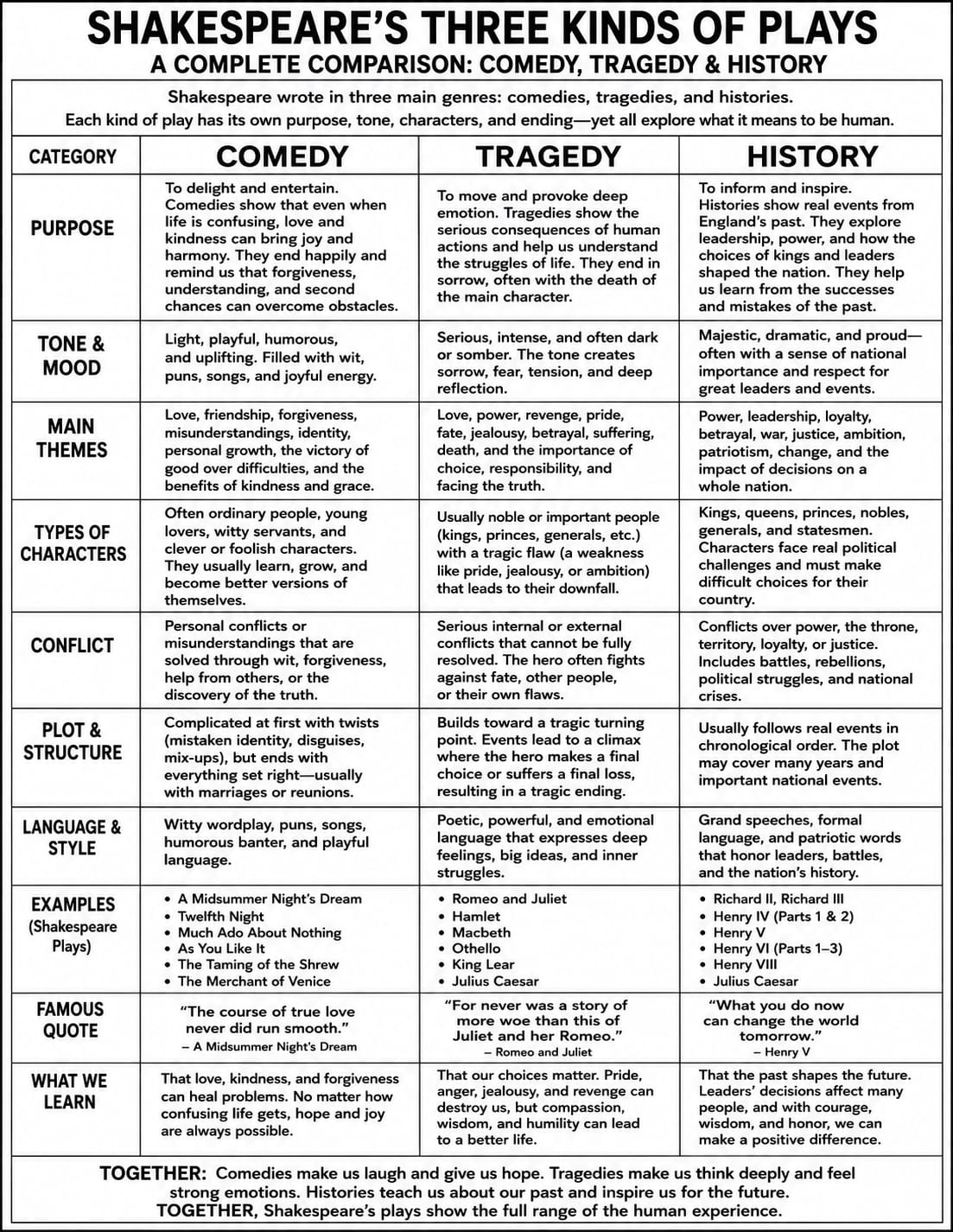
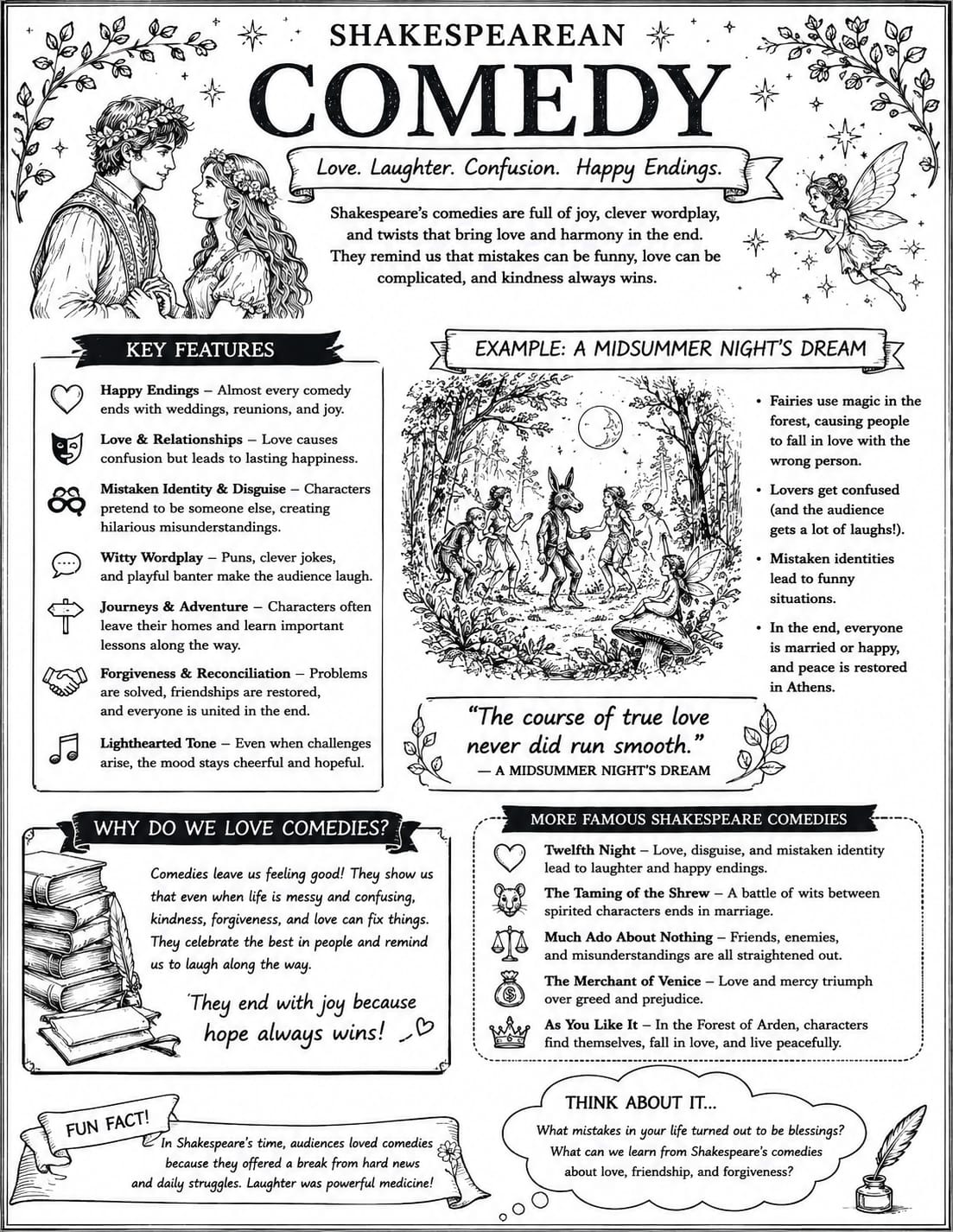
Preview shown above. Love, confusion, wordplay, identity, reconciliation.
Open original ↗
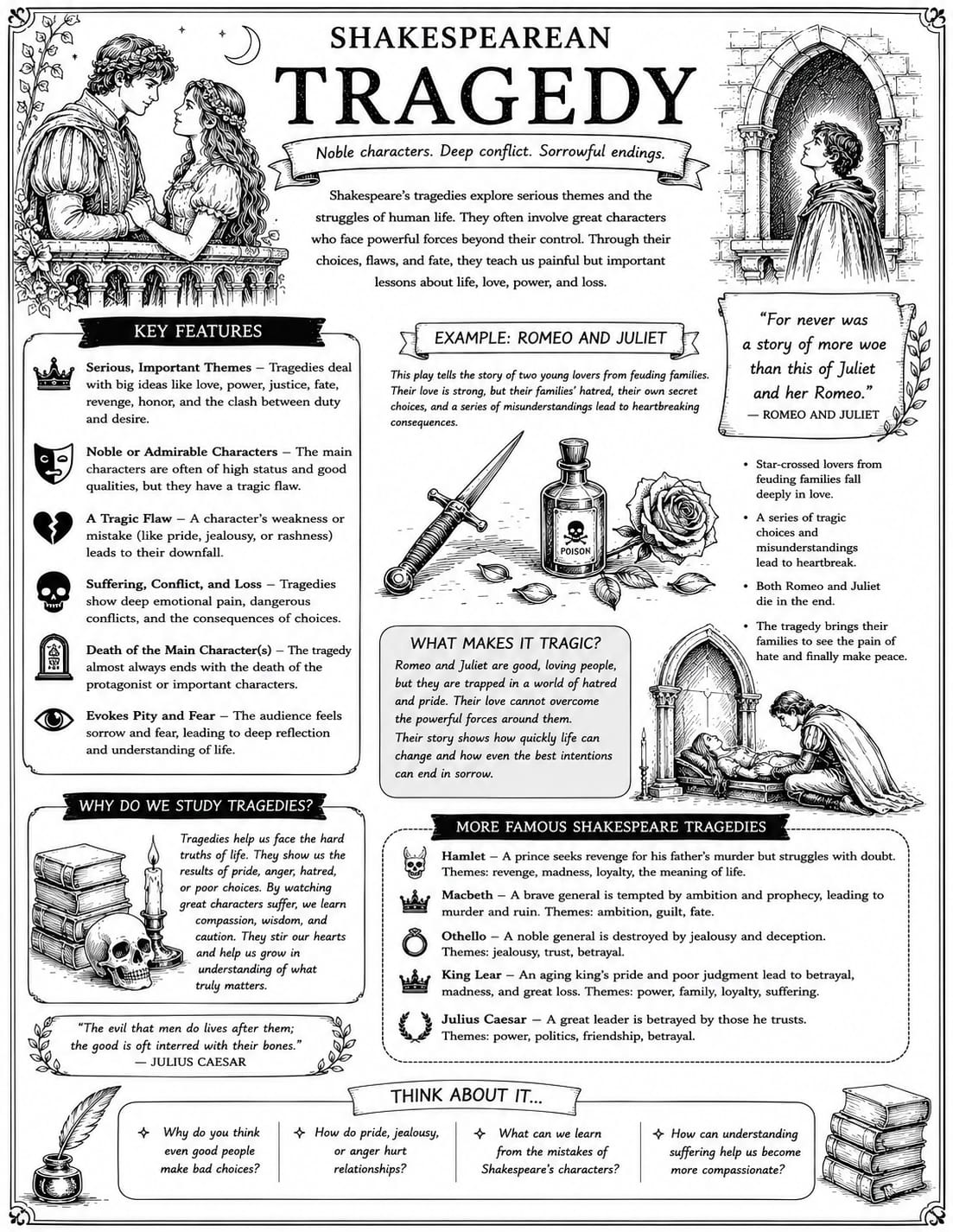
Preview shown above. Deep conflict, choice, suffering, consequence.
Open original ↗
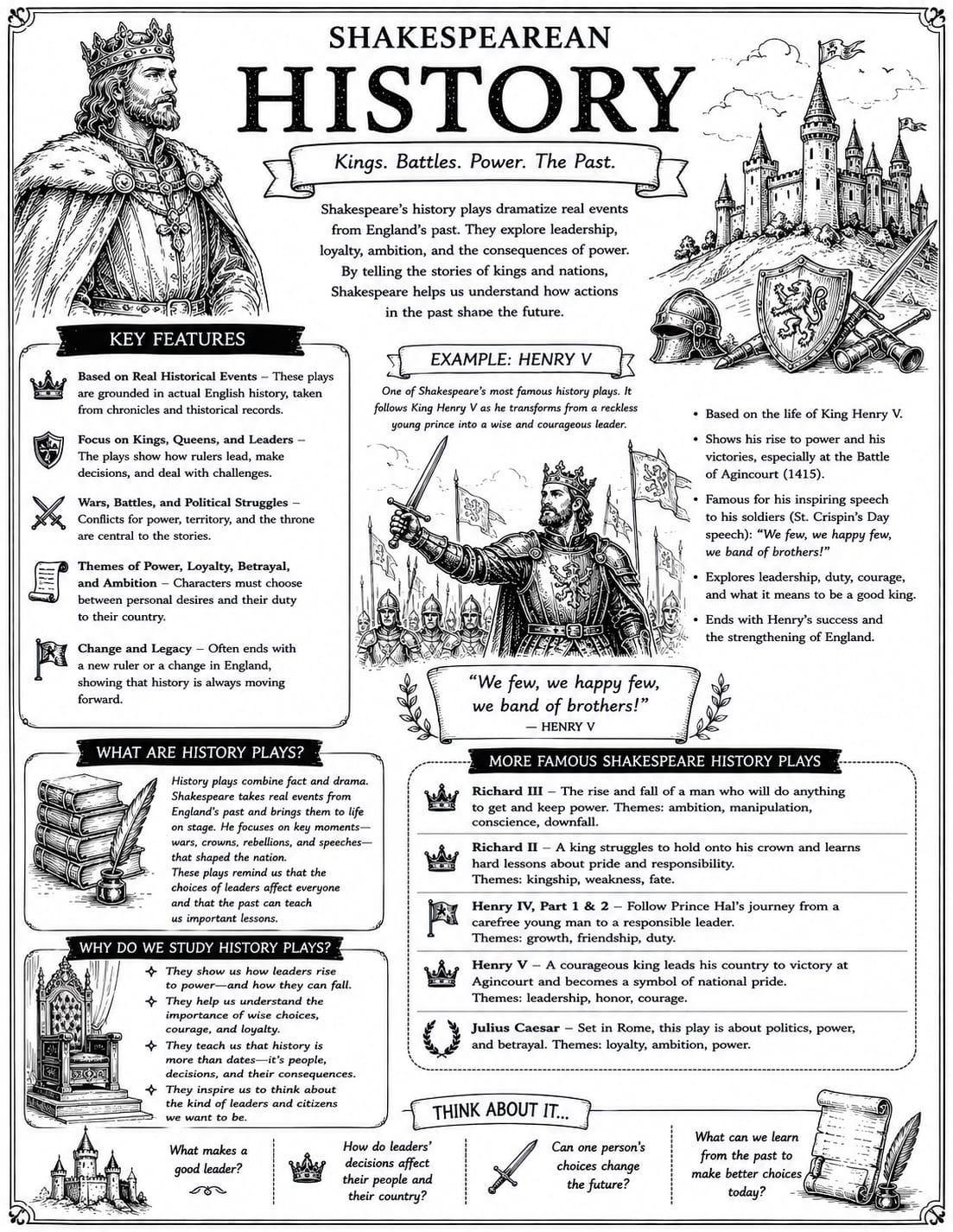
Preview shown above. Kings, power, leadership, loyalty, conflict, and England's past.
Open original ↗Keep these as “for the child who wants to know more” resources. Shakespeare remains the glue; the history of comedy gives curious families trails to follow.
Aristophanes, satire, chorus, civic performance.
Domestic confusion, clever servants, twins, stock situations.
Masks, professional troupes, physical comic types, improvisation.
Roman plot machinery + English language + stage energy.
Double acts, routines, doors, pacing, callbacks.
Visual gags, pantomime, chases, escalation, precise physical timing.
Because students already know the story, relationships, language, and comic devices, rehearsal can begin from familiarity rather than confusion.
Meet the adapted script, receive roles, explore characters, begin memorization, and start putting selected scenes on their feet.
Build the abbreviated production through rehearsal, comic timing, movement, scene work, transitions, and simple production elements.
Bring the selected scenes together, add costumes and props, practice entrances and transitions, and prepare for our final performance and cast celebration.
Coming soon: casting information, the adapted script, memorization helps, rehearsal calendar, costume and prop ideas, family volunteer opportunities, and performance details.